

 Back
Back 


NetSuite Is Powerful — and Built to Be Modular
NetSuite is a leading cloud ERP, with its modular architecture a key strength. But modular needs aren’t static, and companies must extend functionality over time with new modules and add-ons.
This article lists and explains NetSuite modules and when organizations enhance them with add-ons. It’s also a strategic guide for higher management roles evaluating or optimizing NetSuite, with a focus on enhancing AP performance.
What is NetSuite?
NetSuite CRM (customer relationship management) and NetSuite ERP (enterprise resource planning) are the two standard software packages that are offered by NetSuite. These packages include a wide range of capabilities to support businesses across industries and growth stages.
While NetSuite ERP and CRM provide a strong foundation, businesses often require additional functionality to support specialized processes, industry-specific needs, and increasing operational complexity.
As companies grow, especially through multi-subsidiary structures and global expansion, the need for additional modules becomes more important to support scale.
What NetSuite Core Modules Typically Include
NetSuiteʼs core ERP and CRM packages include foundational capabilities across finance, operations, and customer management.
For example, NetSuite ERP has all of the following features:
- Accounts Payable
- Accounts Receivable
- General Ledger
- Multi-Currency and Multi-Language
- Item and Basic Inventory Management
- Project Management
- Bank Management & Reconciliations
- Purchasing
- Employee Center
- Acceptance of Credit Cards, ACH, and EFT
- Order Management
NetSuite CRM includes the following features in its modules:
- Sales Force Automation / Opportunity Management
- Contract Renewals
- NetSuite CPQ (configure, price, quote)
- Marketing Automation
- Partner Relationship Management
- Customer Service Management/Case Management
NetSuite Add-On Modules by Functional Area

NetSuite add-on modules extend functionality across finance, supply chain, manufacturing, HR, commerce, and analytics.
Some NetSuite modules are included with the NetSuite platform. Others are add-on NetSuite ERP modules that, if selected, handle your unique business processes at an additional cost. The functionality of certain NetSuite add-on modules, including Work Orders and Assemblies, may be included in other NetSuite modules.
A NetSuite modules list (that includes the best) is:
Financial Management Modules
These modules support core financial operations, including budgeting, revenue recognition, subscription billing, and financial planning. For example, Advanced Financials enables real-time variance tracking, while Revenue Management automates compliance with revenue recognition standards.
Analytics Module
- SuiteAnalytics provides built-in business intelligence tools for reporting, dashboards, and data analysis across entities.
Order Management Module
These modules help businesses manage order processing, fulfillment workflows, and order visibility across channels.
Procurement Module
- NetSuite Procurement streamlines purchasing processes, vendor management, and spend control across the organization.
Production Management Modules
These modules support manufacturing operations, including production planning, quality control, and work order management for complex products.
Supply Chain Management Module
- Supply and Demand Planning supports supply planning, demand forecasting, and coordination across supply chain operations.
Warehouse & Fulfillment Module
These tools enable multi-location warehouse operations, inventory tracking, and fulfillment optimization.
Human Capital Management (HCM) Modules
HCM modules manage employee data, payroll, performance, and workforce operations across the organization.
- SuitePeople HR (human resources for workforce management)
- Suite People Payroll
- Suite People Performance Management
Professional Services Automation (PSA) Modules
PSA modules help services organizations manage projects, allocate resources, and track profitability through centralized dashboards.
Omnichannel Commerce / Suite Commerce
Commerce modules unify eCommerce, in-store, and customer experiences into a single platform for omnichannel operations.
Customer Relationship Management (CRM) and CPQ Modules
Together, these modules support a wide range of business functions, allowing organizations to tailor NetSuite to their operational and growth needs.
AP Automation is a Key Component of NetSuite Migration
A third-party AP automation add-on during (or after) NetSuite implementation enhances the capabilities of your core NetSuite ERP.
Where Companies Commonly Extend NetSuite
Add-ons are a natural evolution as your business grows in complexity and expands internationally. These extensions enhance NetSuiteʼs capabilities without replacing its core ERP framework. As financial operations become more complex, many organizations extend NetSuite with specialized solutions.
Common triggers for NetSuite add-ons include:
- Increased invoice volume
- Multi-subsidiary growth
- International expansion
- Tax and compliance complexity
- Advanced approval workflows
- Real-time payment reconciliation needs
Among these areas, accounts payable is often one of the first functions organizations extend, as increasing invoice volume, global payments, and compliance requirements quickly outgrow native workflows, making automation a key focus during NetSuite implementation and expansion.
Many teams start by reviewing the best AP automation solutions for NetSuite to compare how different solutions differ before selecting an add-on.
Planning AP Automation During a NetSuite Migration
Migration is an opportunity to optimize accounts payable. Many teams focus on reporting and overlook automation. Planning add-ons early reduces post-go-live friction.
AP automation solutions that integrate with NetSuite can help:
- Automate AP, global payouts, employee expenses, and procurement
- Improve your data quality
- Reduce operational risk during and after NetSuite migration
Pro Tip: Plan your AP automation strategy before migrating to NetSuite, not after. For a step-by-step approach, see our NetSuite migration guide.
Reduce Migration Risk with Better Data Quality
AP automation improves data quality by replacing manual data entry with automated workflows that reduce errors. For example, self-service supplier onboarding helps improve accuracy for vendor records, tax forms (W-9/W-8), and payment details.
Support Global, Multi-Subsidiary Growth
Automation platforms are designed to scale with global, multi-subsidiary operations, enabling entity-specific workflows while maintaining centralized visibility.
Enhance Productivity with AI and Automation
AI-driven automation helps streamline invoice processing, approvals, and reporting by identifying anomalies, reducing manual work, and enabling faster decision-making. Some platforms also offer AI assistants to generate reports and analyze spending through conversational queries.
Strengthen NetSuite Integration for a Smoother Migration
Deep integrations with NetSuite can provide sandbox testing environments before go-live, along with real-time payment reconciliation that improves data validation during migration and increases efficiency after implementation.
Streamline Global Payments and Compliance
AP automation platforms can support global payments across multiple countries, currencies, and payment methods, while helping ensure regulatory and tax compliance.
Future-Proof Your NetSuite Investment
Expanding NetSuite with integrated automation solutions helps future-proof financial operations by improving efficiency, scalability, and control.
Extending NetSuite for Advanced AP Operations
AP automation is a common extension point for your NetSuite ERP system. Tipalti integrates with Oracle NetSuite to close key AP automation gaps, reducing manual work, improving visibility, and strengthening compliance.
See how Tipalti’s AP automation integrates with NetSuite to improve efficiency and visibility:
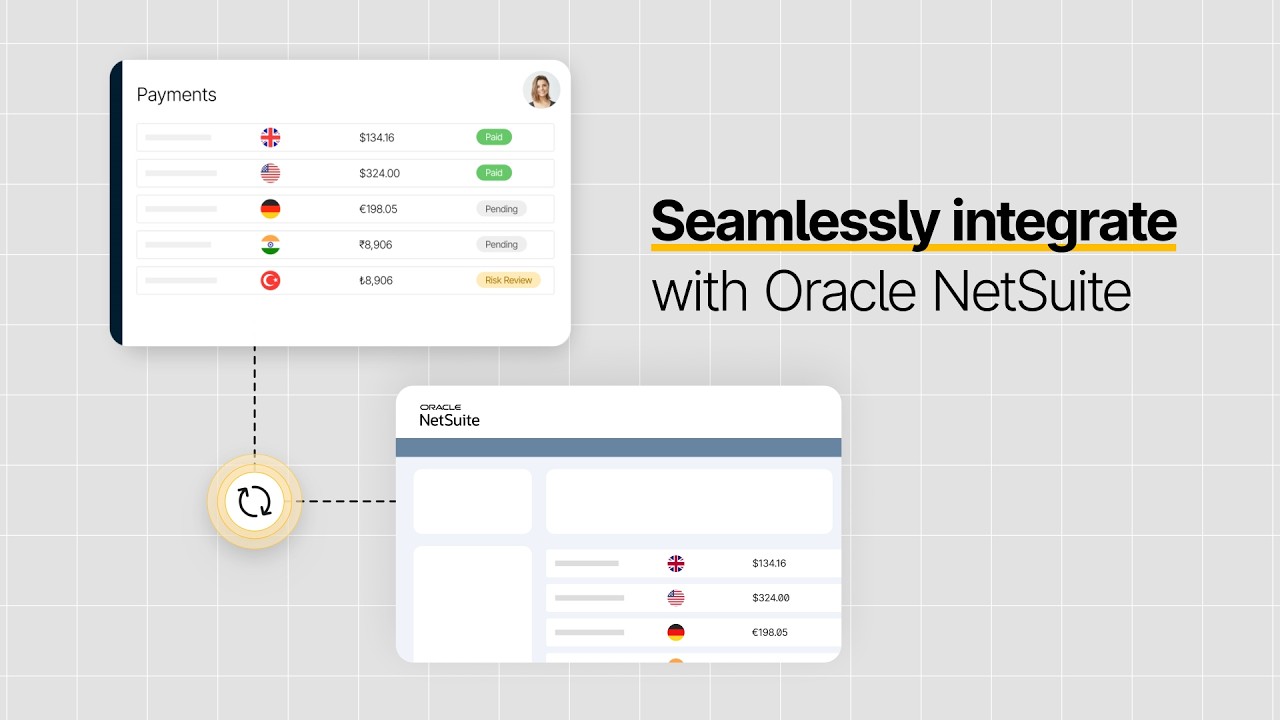
Whereas native accounts payable (AP) handles core accounting, Tipalti layers in automation for:
- Invoice capture
- Approval routing
- Global payments
- Tax compliance
- Multi-subsidiary consolidation
Invoice Capture, Invoice Processing, and Approval Routing
Tipalti uses OCR and AI agents for invoice capture and invoice processing, including approval routing and global payments.
For each batch, Tipalti displays cash flow requirements before making payments. AP automation provides real-time batch payment reconciliation by syncing subledger data with your NetSuite ERP.
Global Regulatory and Tax Compliance
Tipalti screens sanctions lists and performs automated global regulatory compliance checks before making large-batch global payments.
Tipalti simplifies tax compliance by collecting tax forms through self-service payee onboarding before the first payment and by providing simple tax preparation reports. Tipalti has native payments integration with optional, partnered Zenwork Tax1099 e-Filing software for 1099-MISC, 1099-NEC, and 1042-S information returns.
Deep Integration and Real-Time Data Sync
Tipalti integrates with NetSuite at the subledger level, syncing payables, expenses, and payment data in real time. It also supports sandbox testing before go-live and automates procurement workflows, including the creation of purchase orders from approved requisitions.
Multi-Subsidiary
With Oracle NetSuite ERP or NetSuite OneWorld, Tipalti provides payables solutions for multi-national, multi-subsidiary companies. Each of your entities can use the Tipalti automation add-on for accounts payable, and you get combined-entity visibility at the corporate level.
Tipalti’s NetSuite AP automation solutions include Tipalti AP automation and Tipalti Mass Payments for global payouts. Tipalti also offers employee Expense Management and advanced FX solutions (including Multi-FX and Hedging for payables).
AI-Driven Automation and Insights
Tipalti uses AI agents to streamline and automate business workflows, producing enhanced productivity. Tipalti AI Assistant lets you instantly generate custom reports from conversational queries to analyze spending and accounts payable. By integrating Tipalti with NetSuite, you can maximize your ERP investment.

We were looking for something that made the approval process better. We liked the efficiency of Tipalti’s approval flow and its simplicity was very user friendly and integrated well with NetSuite.
Byron Whitman, Corporate Controller, Next Insurance
Maximizing NetSuiteʼs Value Through Strategic Extensions
NetSuite’s core modules are strong, and its modular architecture is intentional. But third-party add-ons extend value. Many organizations enhance NetSuite to support modern finance complexity.
Scalable ERP environments combine NetSuite core modules with purpose-built integrations. Explore Tipaltiʼs NetSuite integration.
NetSuite Modules FAQs
What are NetSuite modules?
NetSuite modules are extra functional and technical software integrations offered by NetSuite to expand the core ERP system at an additional price.
How many NetSuite modules are available?
Over 30 NetSuite modules, grouped into 13 functional areas, are available to add to your NetSuite ERP to meet specific business needs.
Can NetSuite be extended with third-party integrations?
Yes. NetSuite can be extended with add-ons of partnered, NetSuite-approved third-party integrations (SuiteApps). Examples include accounts payable and global payouts automation, as well as Salesforce connectors enabling Salesforce CRM integrations.
NetSuite Connector is a pre-built Oracle NetSuite tool for connecting NetSuite ERP with third-party apps that expand its functionality.
When should companies add AP automation to NetSuite?
Companies should add AP automation to NetSuite either during the initial NetSuite migration or later, when multi-subsidiary growth and global business expansion complexity drive the need for a scalable, tax-compliant solution.